Contact Us
REQUEST A CNC OR STAMPING SERVICE QUOTE FROM OUR EXPERTS TODAY!
Upload files ( Max file size: 20MB )

In CNC turning, nothing destroys surface finish, tool life, or dimensional accuracy faster than chatter, tool deflection, and tolerance drift. These issues become especially challenging when machining long, slender, thin-walled, or high-precision components—exactly the types of projects where manufacturing consistency matters most.
At MAXTECH CNC, where our specialty is tight-tolerance precision CNC turning services for high-complexity parts, controlling these instability factors is a daily priority. In this guide, we break down the real causes of turning-related vibration and dimensional inaccuracy and share practical machining strategies that help ensure repeatable, production-grade quality.
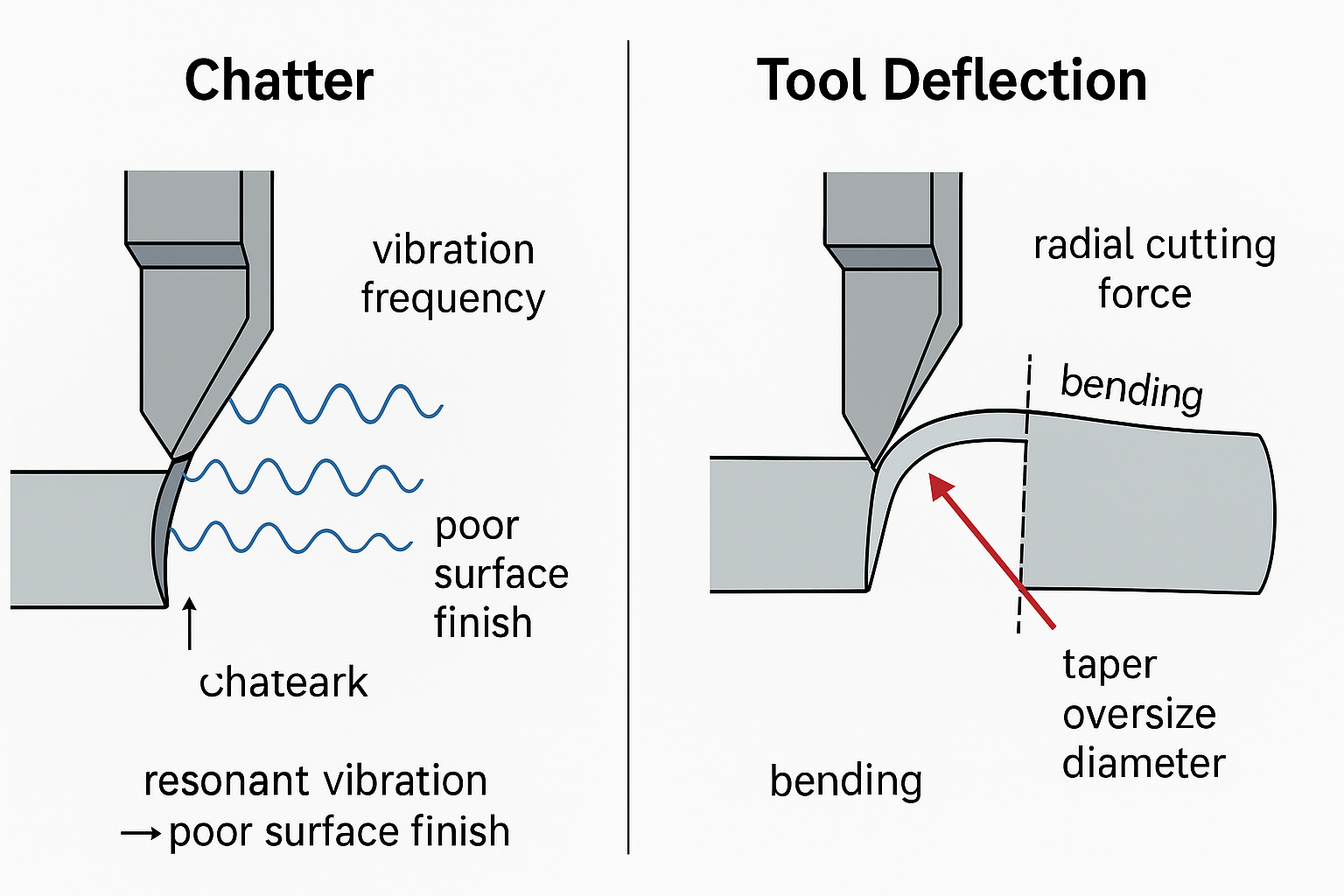
Chatter and deflection are often grouped together, but they originate from different mechanical sources—and require different corrective actions.
Chatter occurs when the cutting tool, workholding, or workpiece vibrates at a harmonic frequency.
Common causes include:
Insufficient rigidity in the setup
Excessive stick-out of bar stock or boring bars
Incorrect cutting parameters (RPM, feed, depth of cut)
Dull or inappropriate inserts
Tool engagement forces exceeding structural stiffness
Tool deflection is the bending or flexing of the tool or workpiece during cutting.
This typically occurs with:
Long, slender “noodle” parts
Deep internal bores
Thin-walled components
High cutting loads causing systematic deviation
Deflection rarely shows up as chatter—it shows up as tolerance drift, undersized bores, taper, or inconsistent diameters.
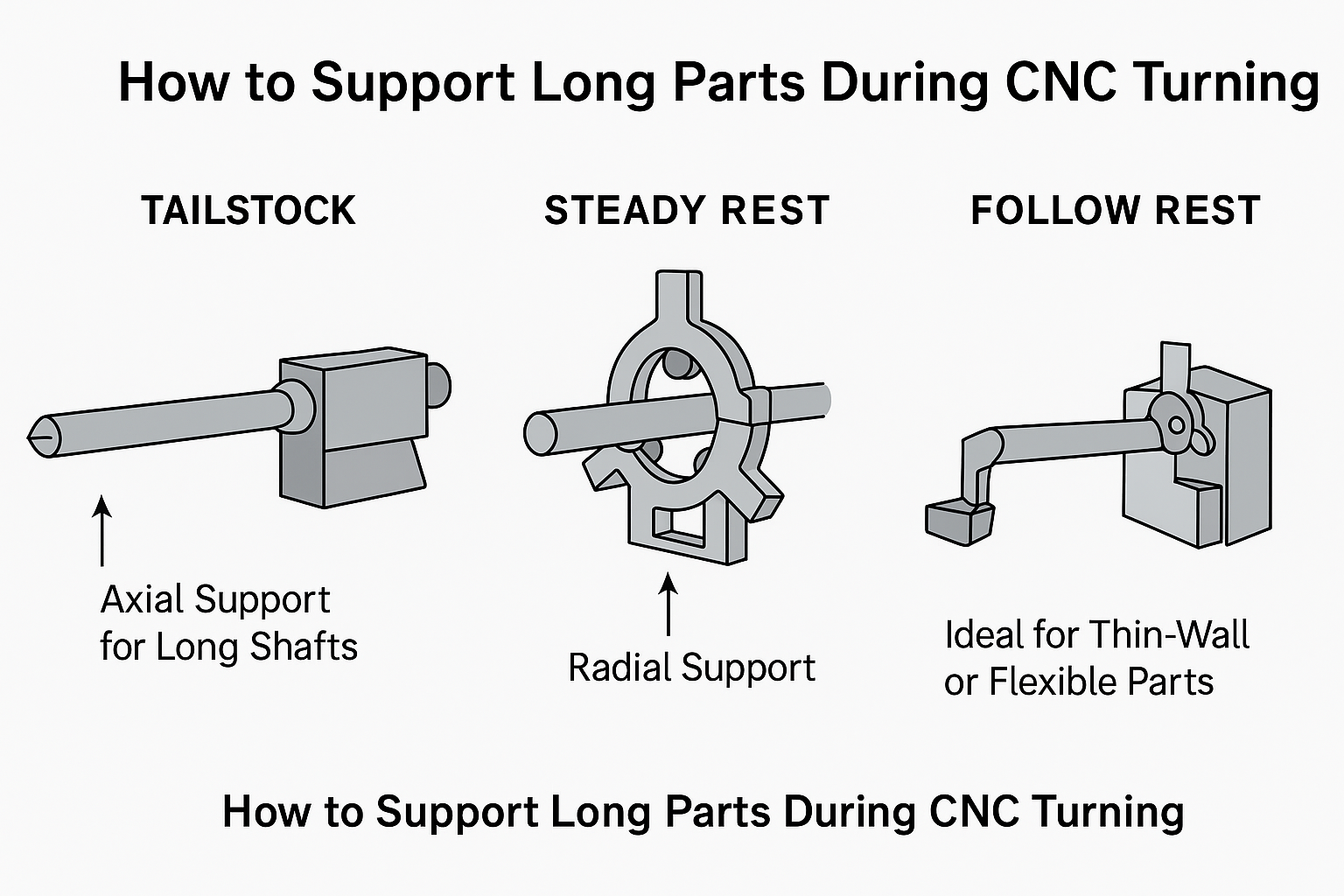
For demanding long-part machining, support systems are mandatory.
Tailstock: Best for axial support during turning
Steady rest: Prevents radial movement on long shafts
Follow rest: Travels with the carriage for thin flexible components
A part that deflects even 0.05 mm can lead to oversized diameters or unpredictable tapers. MAXTECH CNC frequently uses multi-support setups on aerospace shafts, instrumentation parts, and precision pins to guarantee straightness and dimensional stability.
The rule of thumb
Tool overhang should be no more than 1.5× the bar diameter.
For boring bars, exceeding 5× can drastically increase deflection.
Best practices:
Use the largest diameter boring bar that fits the bore
Use carbide or damped boring bars for deep holes
Switch to anti-vibration bars if stick-out > 8×D
To minimize bending forces:
Lower depth of cut (DOC)
Increase feed slightly
Use sharper inserts
Reduce tool nose radius
A smaller nose radius reduces radial cutting force, directly lowering the risk of deflection.
Every machine-tool-workpiece combination has certain spindle speeds that excite vibration.
If chatter occurs:
Decrease spindle speed by 10–20%
Or increase speed to skip the resonant frequency zone
This simple adjustment instantly eliminates chatter in many cases.
Insert choice affects stability more than most operators realize.
Stable for chatter-prone workpieces:
Positive rake
Sharp cutting edges
Small nose radius
High-polish chipbreakers
Less stable but stronger:
Negative rake
Heavy nose radius
Thick inserts
At MAXTECH CNC, we regularly choose optimized insert geometries when machining aerospace aluminum, stainless steels, and precision brass components to maintain surface finish and dimensional repeatability.
Chatter thrives in flexible systems.
Improve rigidity by:
Using shorter toolholders
Using thicker, stiffer boring bars
Ensuring proper chuck pressure
Switching to soft jaws or custom jaws
Using collet-style chucks for small diameters
Even a small increase in setup rigidity can dramatically reduce vibration amplitude.
Tolerance inconsistency often comes from internal stresses and heat—not only from chatter.
General rule:
Rough first, allow stress to relieve, then finish
For precision internal bores: finish in the same setup
For long parts: finish with full support (tailstock/steady rest)
If roughing removes a large amount of material, the part can subtly move as stress is released. This is why aerospace components are often rough-machined, stress-relieved, then finish-machined.
When used properly (G96), CSS improves:
Consistent cutting load
Better chip control
More even tool wear
But excessive CSS at small diameters generates heat—leading to tolerance growth.
Thermal growth affects:
The tool
The spindle
The part itself
In production environments, tolerance drift usually becomes noticeable once the spindle has been running for a period of time.
Professional strategies used in precision machining:
Pre-warm spindle cycles
Controlled coolant temperature
Avoiding long dry-running periods
Taking measurement at consistent temperature intervals
MAXTECH CNC uses climate-stable machining cells to ensure repeatability for medical, robotic, and defense components where tolerances often fall within ±0.005 mm.
Threading is one of the most sensitive turning operations due to high radial load and multiple passes.
Incorrect insert geometry magnifies forces and increases chatter risk.
Essential steps:
Set tool perpendicular to thread axis
Touch off flank using magnification or optical probes
Use G76 or G32 with slight radial offset
Adjust tool wear comp (G41/G42) if the thread is undersized/oversized
Picking up threads is a common service at MTCNC for repair parts, custom adapters, and re-machining operations.
Here is a practical summary that machinists and engineers use daily:
Lower/increase RPM to escape resonance
Increase rigidity at every node
Use sharper inserts
Shorten tool overhang
Use proper workholding
Use tailstock, steady rest, or follow rest
Reduce DOC, increase feed
Use anti-vibration bars
Increase part support
Separate roughing and finishing
Allow time for stress relief
Control heat
Maintain consistent measurement routines
Chatter, deflection, and tolerance drift are unavoidable challenges in CNC turning—but with the right strategy and setup, they can be controlled to achieve highly consistent, repeatable precision.
At MAXTECH CNC, these techniques form the foundation of our workflow for manufacturing tight-tolerance, complex CNC turned components for industries where precision matters most—medical, aerospace, robotics, instrumentation, automotive, and more.
If you need reliable, high-accuracy CNC turning for prototype or production parts, our team can help ensure your components meet the highest standards of dimensional stability and surface quality.